
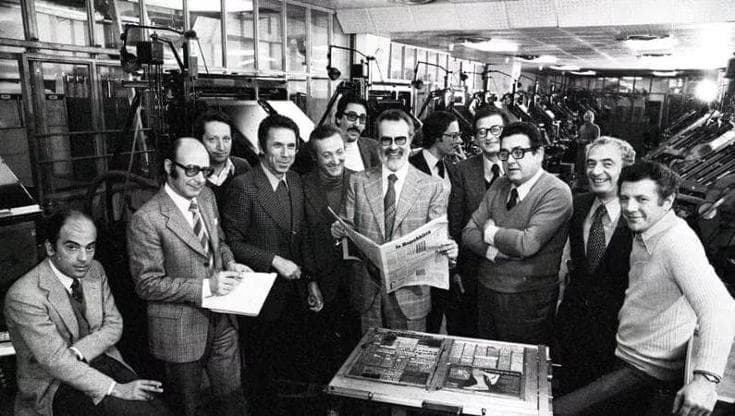
Long-standing readers of La Repubblica often repeated a phrase: ‘I’ve been buying it since the very first day it came out.’ That was 14 January 1976. They often added: ‘I still have that issue.’ Just think how much care it has taken to preserve those newspaper pages and shield them from the passage of time, from house moves, life changes, divorces and life’s unforeseen events.
Repubblica50, il documentario

Repubblica is not a newspaper like any other. Let’s be clear: this does not mean it stands on a pedestal. The concept is literal: Repubblica is different. Its history bears this out. Above all, its readers demand it. To get a sense of this uniqueness, we might turn to a famous line by Nanni Moretti: ‘We are the same as others, yet we are different.’ This is a daily newspaper founded to bring together a community of people who share a common civic vision – not necessarily the same electoral choices or approval of this or that leader – but who certainly demand journalism that is rigorous in its reporting of the facts and capable of drawing on a civic and political ethos: social justice, rights, ethical progress and freedom. There is no recent period in world history in which these achievements, without exception, have been so tangibly called into question.
A newspaper that, right from its very first issue with that iconic headline – ‘The seat of power is empty’ – chose to transform journalism with the aim of transforming the country. This was the vision of its founder, Eugenio Scalfari. A partisan but not a partisan-biased daily. Being partisan means always having a clear perspective on matters, a vantage point that articulates values in order to put them to the test and bring them to life. Being partisan, on the other hand, means abandoning doubt. It means never questioning the contradictions within one’s own camp and merely highlighting those of the opposing camp. It means failing to grasp the nuances that every news story inevitably carries with it. La Repubblica was founded on the principle of never taking positions that are a foregone conclusion. It aims to guide readers, with intelligence and restraint, through the complexity of issues: to reflect, to be convinced – or even not to be convinced – but in any case to escape the clamour of tribal conflict, that which is devoid of thought.
Repubblica has already evolved alongside its readers over the past fifty years. It will continue to do so, making the best possible use of all available tools. This includes maintaining the quality of the print edition, strengthening the website and developing the opportunities offered by digital journalism. But it is not the medium that defines or alters the essence of a newspaper’s mission. The seat of power needs to be properly filled, and information is a primary asset of our fragile yet invaluable democracies.