
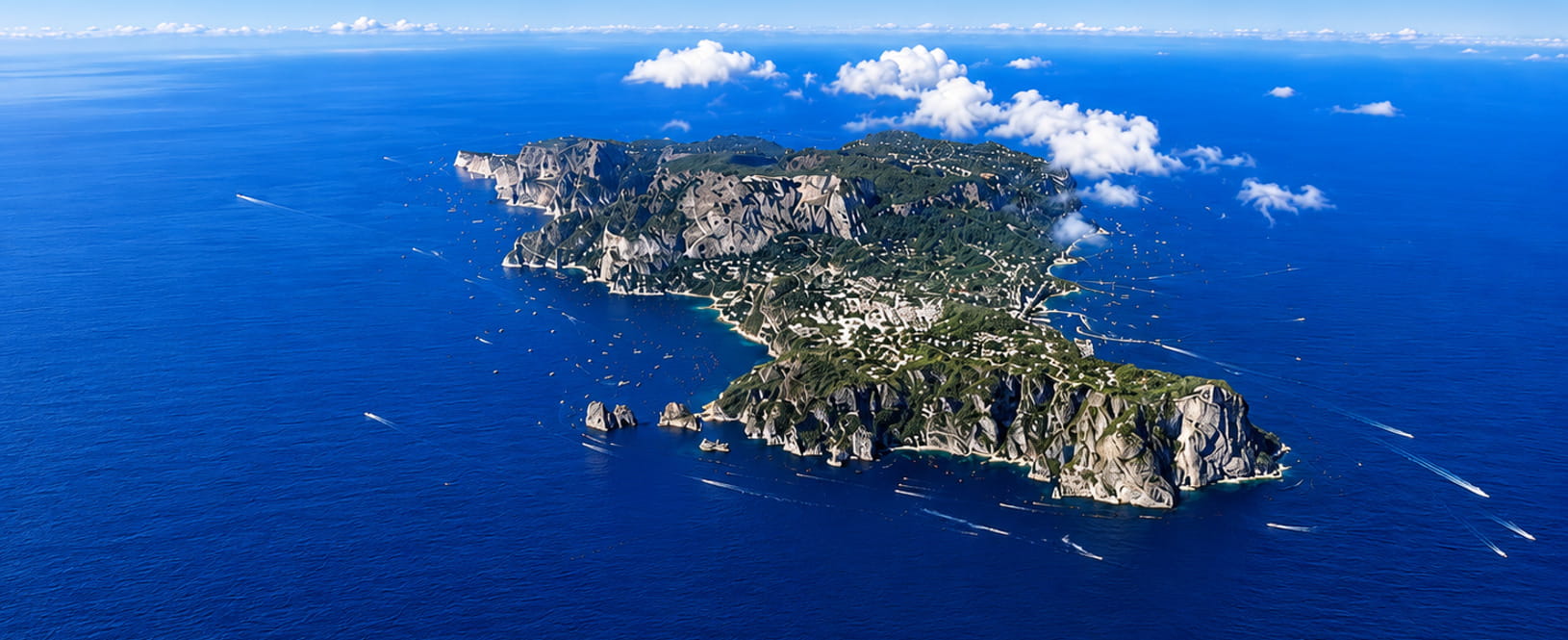
Not merely a pigment, nor a static expanse of colour, but a luminous and fluid phenomenon born of the interplay between light, water and rock. And perception.
As part of the celebrations marking the bicentenary of the rediscovery of the Blue Grotto (1826–2026), the ‘blue island’ is hosting a major event: On Thursday 13 August, in Capri at the Serena Messanelli Zweig Foundation and as part of the ‘Quattro Parole ed un Suono’ programme organised by the Serena Messanelli Zweig Foundation and IACC Italia ETS (Italian Association of Colour Consultants and Designers), colour designer Massimo Caiazzo will deliver a lecture entitled ‘The Blue of Capri. When Physics Becomes Poetry’.
The modern history of the Blue Grotto officially began on 18 April 1826, when the German poet and painter August Kopisch and his colleague Ernst Fries, defying ancient popular superstitions, swam into the rock cavern, guided by the Capri fisherman Angelo Ferraro. Already known in Roman times and used by Emperor Tiberius as a nymphaeum, from that day in 1826 the Grotto re-entered the romantic and international imagination, captivating generations of artists, writers and travellers. But what makes its light so otherworldly? As Massimo Caiazzo explained during his talk, the intense blue that envelops the grotto is not a property of matter, but of light itself. The sun penetrates the rock cavity mainly through a large submerged opening: as it passes through the water, the light spectrum is filtered and the blue wavelengths – scattering more effectively in the liquid medium – are diffused across the rock walls. The blue of the cave varies constantly with the passing of the hours, the sun’s angle, the tides and the observer’s position. It can shift from cobalt to turquoise, from ultramarine to blue-green.
Through the physiology of vision, the history of pigments, Mediterranean architecture and art history, the chromatic journey proposed by Caiazzo will bring optical physics into dialogue with the sensibility of the great masters, from the Byzantine mosaics of Ravenna to Giotto, via Picasso, Matisse and the immaterial vertigo of International Klein Blue (IKB).