
A group of French schoolchildren is milling noisily around Bernini's Apollo and Daphne. But up in the offices on the upper floors, neither the commotion in Villa Borghese – a thoroughly Caravaggesque brawl over a surreptitiously taken photograph – nor the subdued murmur of visitors wandering through the galleries, overwhelmed by so much beauty, can be heard.
I have known Francesca Cappelletti, director of the Galleria Borghese since 2020, for years. Her publications, and the exhibitions she curates, have become regular fixtures. I have come to discuss her latest book, Caravaggio. Una vita in dieci quadri (Caravaggio: A Life in Ten Paintings), published by Mondadori. A biography of perhaps the best-known and most beloved Italian painter in the world. Another one, some might object. A new one, one might reply.
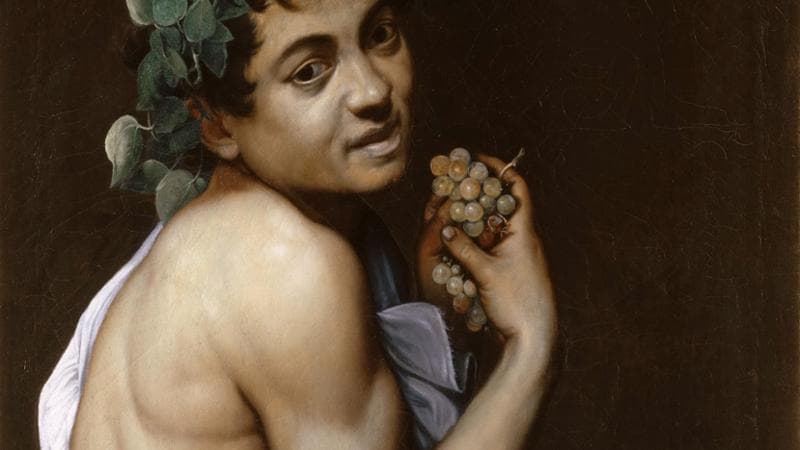
"The subtitle of my 2009 monograph was Un ritratto somigliante (A True Likeness)," the author explains, "because the question of self-portraiture is central to art history, and even more so to Caravaggio.
"The great masters very often worked on their own image. We can follow Rembrandt from youth to old age. Artemisia also used herself as a model, and nowadays we talk about 'self-fashioning' in relation to the images women artists created of themselves. It was crucial for women to present themselves in a way that patrons would find acceptable and attractive, but this was not exclusively a female concern. And Caravaggio's decision to portray himself as a sick Bacchus gives us plenty to think about."
That is the subject of the first chapter.
Michelangelo Merisi, born in Milan and trained under Simone Peterzano but already working independently, arrived in Rome "without an address or means of support". He worked in the workshops of Lorenzo Siciliano and Antiveduto Gramatica, and in the studio of the Cavalier d'Arpino.
Following an accident – a fall? A brawl? – he was admitted to the Ospedale della Consolazione. Two monsignors, Pucci and Petrignani, both relatively modest figures in the hierarchy of the Roman Curia, offered him accommodation. But Michelangelo knew his own worth, and he knew what he wanted.
"The Young Sick Bacchus is the first self-portrait by Caravaggio that we can identify with certainty," Cappelletti recalls.
"With the fruit in the foreground: still life was considered his speciality. In self-portraits, artists have to make themselves recognisable not only through their physical features but also through their painting technique.
"But the most important thing is that he presents himself as Bacchus, squeezing grapes and inventing wine. An allegory of the artist, of inventio, artistic invention. That is quite something for a young painter down on his luck at the beginning of his career, before he met the important patrons who would propel him to success."
From Caravaggio's Roman period, her particular area of expertise, Cappelletti has selected The Fortune Teller, Judith Beheading Holofernes, and The Calling of Saint Matthew and The Martyrdom of Saint Matthew in the Contarelli Chapel.
Protected by Cardinal Del Monte, the banker Costa and Vincenzo Giustiniani, Caravaggio rose rapidly. He changed his colours and subjects, bringing about his artistic revolution.
He painted from life, using real models, staging biblical and religious scenes with shocking naturalism. His rise was meteoric.
"I chose to focus on paintings that mark pivotal moments and turning points," the scholar says. "There are some dark passages in his life and artistic development, and others that are much clearer. It sounds like a metaphor, because in his paintings he always used light in such an irregular and dramatic way."
The dark gaps in Caravaggio's life
Caravaggio is perhaps the most extensively studied painter of all time. Decades of painstaking and systematic archival research culminated in the 2010 catalogue Caravaggio a Roma. Una vita dal vero (Caravaggio in Rome: A Life from Nature), published to mark the 400th anniversary of his death.
Yet there is a stark contrast between the wealth of detail surrounding certain episodes, such as the murder of Ranuccio Tomassoni, and the profound darkness surrounding other periods of his life.
What did he paint in Milan? Why did he leave? His biographer Mancini alludes to the death of a friend, perhaps a murder. Where did Caravaggio go?
"We cannot be certain that he came to Rome immediately after his mother's estate was divided in 1592," Cappelletti argues.
"That would leave us with far too few paintings for an artist who needed to work for the market and earn a living. But compressing all the events and works into the period beginning in 1596 or 1597, given the enormous stylistic differences, is equally problematic.
"And then there is an argument from silence. It’s hard to believe that he could have spent four years in Rome without attracting any attention.
"He produced devotional copies, studies of heads and portraits, including one of an innkeeper. We have not identified this body of work, even though it was extensive and produced in series."
"I asked myself," the scholar continues, "whether I should write a traditional biography or a new, updated monograph that took account of a bibliography which has grown exponentially.
"Catalogues must include securely attributed works, disputed attributions and rejected works, and at the moment it is impossible for me to examine them all.
"So I chose a different approach. Limiting myself to just ten paintings was painful. One of my favourites, The Incredulity of Saint Thomas, for example, is not included. But the selection is never arbitrary. Each painting represents a moment in his biography or stylistic development."
The story behind The Fortune Teller
Cappelletti has written extensively about Caravaggio and curated several exhibitions. Questions and approaches to interpretation change over time, and this book represents a culmination of her work. But is it also a liberation?
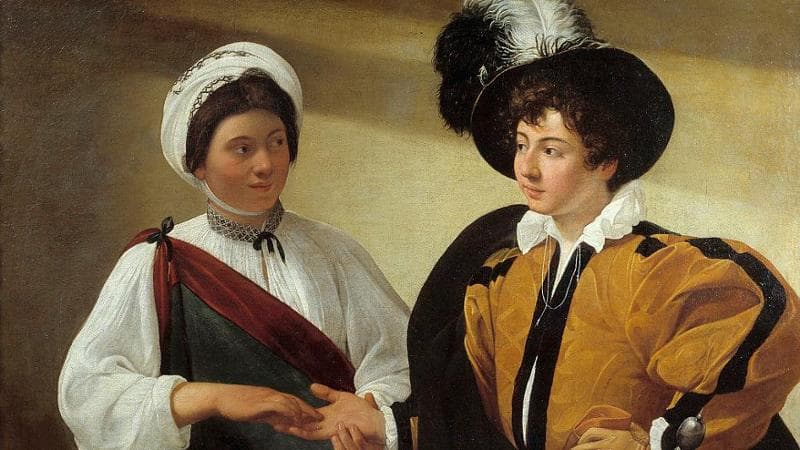
"The Fortune Teller," she says, "marks a turning point. The sources connect it with his meeting Cardinal Del Monte, and that is an objective fact.
"But the fact that it depicts palm-reading, the telling of someone's fortune, introduces a literary dimension that you could never include in a catalogue entry.
"This format gives me the freedom to interpret the character, without going too far or deluding myself that I have understood his 'human side', which remains largely unknown, even if his own voice occasionally surfaces from the documents.
"On the other hand, his personality reveals itself more clearly in the way he approaches subjects that are sometimes quite conventional.
"In some cases, Caravaggio confronts a long iconographic tradition and sweeps it away in an instant. In others, even the subject itself is new. But you need to know what he might have known, and to have studied it for 30 years..."
Is this a book for everyone, including someone approaching Caravaggio for the first time?
"Absolutely. Readers will not be weighed down by specialist debates about dates, discrepancies between sources and so on.
"I have tried not to interrupt the flow of the narrative, and to concentrate the main questions and established facts into 200 pages.
"His works have the ability to speak to people today with extraordinary force, and never to be forgotten.
"It is true that Caravaggio suffered from a lack of critical recognition, but artists understood him immediately. Karel van Mander said that all the young painters in Rome wanted to paint like him.
"That influence has endured. Caravaggio's impact was immense."
The rediscovery of The Taking of Christ
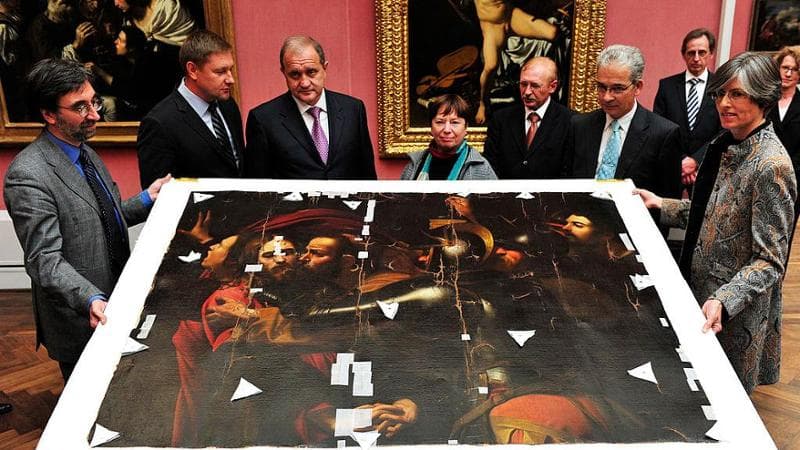
One of the ten paintings Cappelletti has chosen is The Taking of Christ.
The story of its rediscovery was told in Jonathan Harr's 2005 book The Lost Painting.
As a doctoral student, Cappelletti and Laura Testa discovered the inventory of the Mattei collection in Recanati.
"When I saw the name Antìci Mattei in the Rome telephone directory," she recalls, "I plucked up the courage to call. The person who answered helped us.
"The painting had been sold in England, so I went to London. But not all telephone directories are alike.
"There were moments of despair. Professor Calvesi would say: you've traced it as far as 1926 and still can't find the painting? Put an advertisement in The Times..."
In recounting the story of The Taking of Christ, the author thus abandons the detachment of an objective narrative. Yet she almost seems to apologise for the digression.
"At the 2025 exhibition, the painting made a tremendous impression on people who knew nothing about Caravaggio scholarship. The composition of the scene, the expressions on the figures' faces, the rendering of the armour...
"It had to be one of the ten paintings. It represents the height of Caravaggio's glory, after the Contarelli Chapel.
"But I hesitated. I wrote my thesis in the 1980s. We were made to read Umberto Eco's book, in which he said you should never write 'I' in a scholarly essay. That has become part of my way of thinking.
"In my 2009 monograph, there isn't a word about the story of the discovery.
"Here, I could recount it briefly, to show that sometimes works of art come looking for the scholars."
It is a perfect example of how historical research works.
A single line in an archival document can become a thread that sometimes leads all the way to the artwork itself.
The researcher's presence in the narrative strengthens the story.
Learning that Cappelletti has been studying documents relating to Caravaggio since her student days – his patrons, the journeys made by his paintings, often extraordinarily complicated because of the existence of copies – lends authority to her account.
The history of research teaches us how research is done, and can lead to further discoveries.
"Sometimes luck is on your side. Other times you get close and have to stop. It happens often.
"At a certain point, you come up against the wall of history, against silence.
"Other paintings by Caravaggio have vanished. The first version of The Crucifixion of Saint Peter, the companion piece to The Conversion of Saint Paul, now at Palazzo Odescalchi.
"They were sold together. Only one returned to Italy, to Genoa. The other was in Spain until the end of the 18th century. Then perhaps it was destroyed in a fire."
The mysterious death and the enemy in pursuit
Caravaggio's death is another dark chapter.
While we know a great deal about his first stay in Naples, his time in Malta and in Sicily, the geography of his final journey remains mysterious.
The sources say he died on a beach while travelling from Palo to Porto Ercole. But the distance is too great for a man travelling on foot under the blazing sun.
"Especially as he was wounded," Cappelletti observes.
"What we might discover – although perhaps that’s a novel for you to write – is the shadow of the enemy pursuing him.
"In the final period of his life, his flight becomes increasingly frantic, and also involves the patrons who had supported him in Rome.
"But there is a struggle between the protection Caravaggio continues to enjoy and a very real, opposing force.
"Something may yet emerge from the Neapolitan archives, perhaps allowing us to identify the person who was persecuting him.
"It wasn't one of the Tomassoni family. A reconciliation with the family was under way, which would have led to a pardon.
"Perhaps his obsessive, almost blinding desire to return to Rome shortened his life.
"Everything he does in those last four years is driven by that hope.
"Even returning to Naples to board a ship puts him in danger, because he is attacked and disfigured at the Osteria del Cerriglio.
"News of the attack reaches Rome, where he is reported to be almost dead.
"And even afterwards, uncertainty remains. What happened at Palo is unclear.
"In any case, he loses his paintings.
"It sounds like a romantic notion, but it is true. His life was painting.
"Everything he did, he did as a painter. He wanted to return to Rome because that was where he had achieved glory, and losing his paintings caused him terrible anguish.
"A specialist such as Vincenzo Pacelli became convinced that there was a conspiracy against Caravaggio – not the poetic conspiracy of death and nature evoked by Giovan Battista Marino in his famous poem, but an actual plot.
"And Pacelli was an art historian, a professor at the University of Naples..."
Yet the identity of the person orchestrating this persecution remains unknown.
Could it have been a Knight of Malta?
"The biographer Baglione alludes to a specific individual.
"Perhaps he doesn't name him because everyone at the time knew who he was. Or perhaps he couldn't name him.
"But he explicitly says: 'his enemy'."
This article was reviewed by an external translation partner