
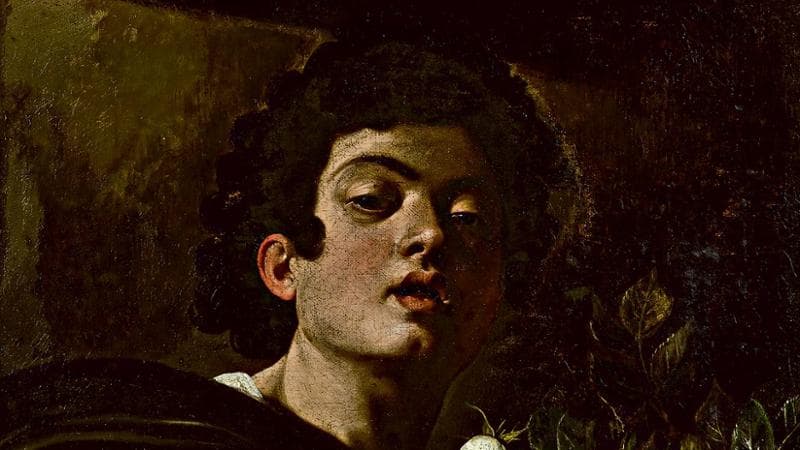
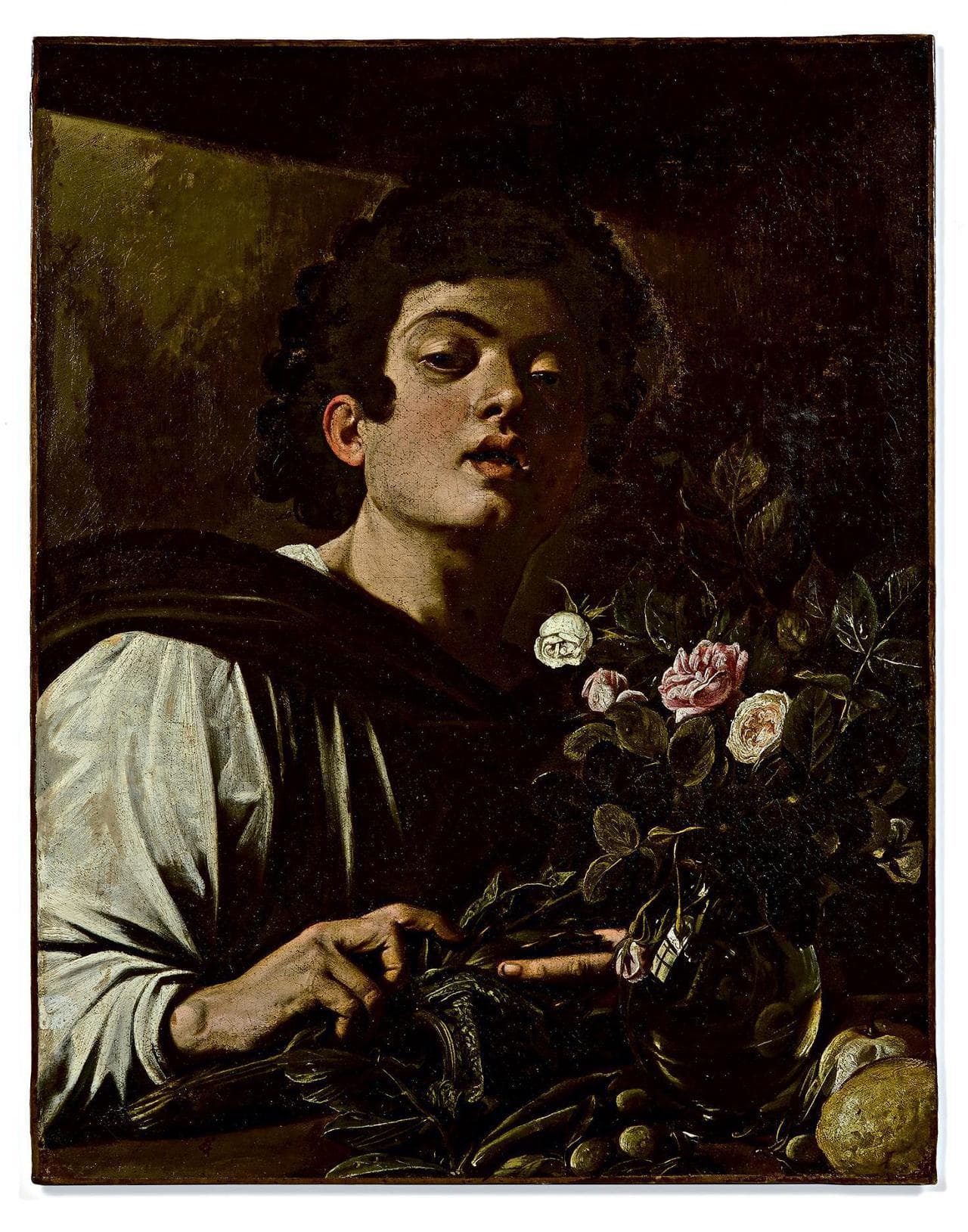
I first came face to face with this magnificent Young Man with a Jug of Roses on a grey winter's day, in the back room of a Parisian gallery. Although covered in grime, I immediately recognised the Caravaggio painting that had fired imaginations for almost a century. Four early copies, one of them held by none other than the High Museum of Art in Atlanta, had long fuelled the suspicion – and the hope – that the original might one day be found. And now, incredibly, here it was before my eyes. Yet once again, in this painting, Caravaggio – and reality itself – had surpassed anything the imagination could conjure up.
A young man, a jug of roses and a hidden reflection
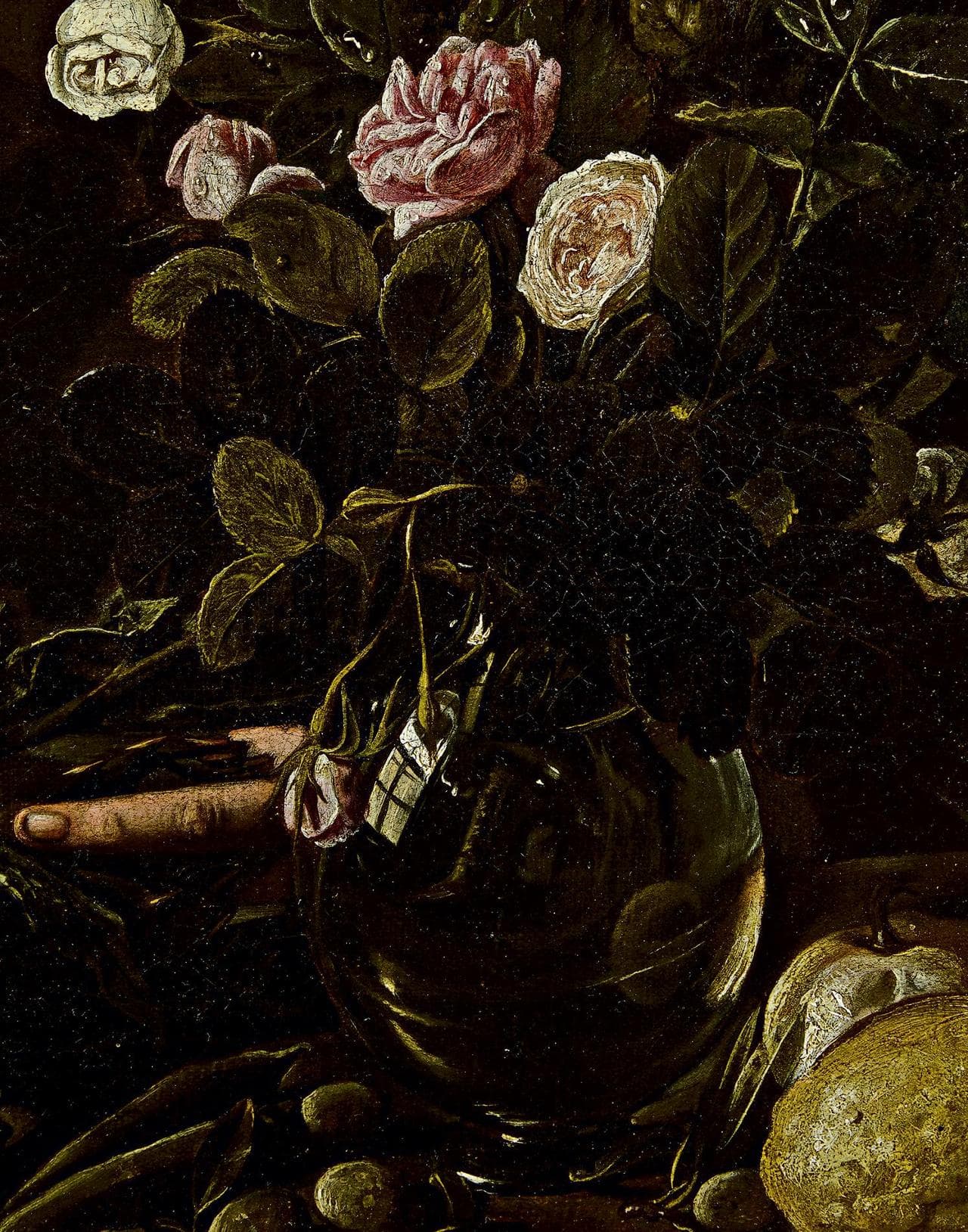
A detail of Young Man with a Vase of Roses, attributed to Caravaggio by Maria Cristina Terzaghi. Photo: Studio Sebert
A dark-haired young man with curly hair is depicted from the waist up, viewed from below. He wears a dazzling white shirt, with a strip of dark fabric crossing his chest, perhaps part of a cloak. He leans against a table laden with fruit and vegetables, including an artichoke, berries and two beautiful lemons, one of them half-peeled. Dominating the table is a jug filled with roses.
His hands grasp the artichoke, his lips are parted and one eyebrow is raised. The young man seems on the verge of speaking, striking an almost theatrical pose.
A shaft of light cuts across the background, sweeping over the wall and refracting through the glass jug and the water within it. In their reflections, we can make out a distant window and another young man dressed in dark clothing with a white collar – probably a self-portrait of Caravaggio himself, in an extraordinary play of mirrors.
Until now, none of the floral compositions in the young Merisi's paintings had come so close to the description of a work he produced for his patron, Cardinal Del Monte: "He painted a jug of flowers, with the transparency of the water and glass, and the reflections of a room's window, the flowers sprinkled with the freshest dew."
These were the grudging words of his rival Giovanni Baglione, who could still recall the painting 30 years later.
Indeed, droplets of water cover the jug and the rosebuds. Everything in this painting is water and light. We are confronted with the enigma of a concealed meaning, yet one that is unmistakable in its freshness and fragrance.
The unmistakable hand of a young Caravaggio
The extraordinary quality of the painting leaves no doubt about its attribution to Caravaggio.
This is evident not only in the compositional invention – a magical harmony of youth, embodied by the boy in his white shirt and the budding roses – but also in the remarkable rendering of his face, his moist eyes, the shifting whites of his shirt and the magnificent still life.
The painting immediately takes its place among the masterpieces of Caravaggio in his early twenties, shortly after his arrival in Rome from Milan, relegating all the other known versions to the status of copies.
From a Paris auction to the Borghese collection
In the three years since that first encounter, I have been able to establish that the painting had been in Paris since at least the beginning of the 20th century.
It belonged to a bookseller whose widow decided to put it up for auction in 1909, catalogued as the work of an anonymous Italian painter. Fortunately for its current owners, their ancestors purchased it on that occasion.
Yet the composition had been well known and admired by Michelangelo Merisi's contemporaries.
On 1 August 1607, it was recorded in an inventory of paintings belonging to the celebrated artist and entrepreneur Giuseppe Cesari, known as the Cavalier d'Arpino, in whose workshop Caravaggio had spent eight months around 1596.
Cesari had been accused of brutally disfiguring a fellow painter, Cristoforo Roncalli, known as Pomarancio, and was put on trial. To escape the full force of papal justice, he secured his freedom in exchange for the confiscation of his magnificent art collection.
The paintings passed into the hands of Pope Paul V, who promptly gave them to his nephew, Cardinal Scipione Borghese.
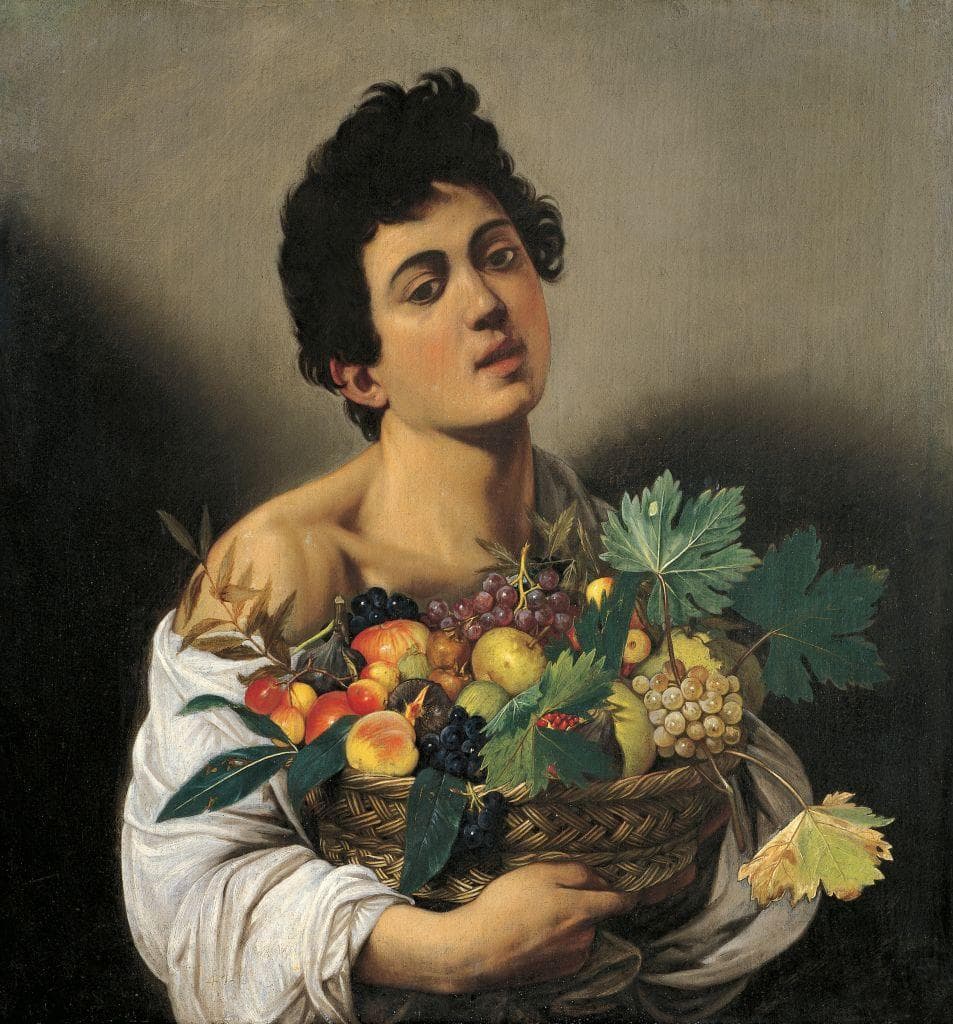
The canvas was still recorded at the Borghese Gallery in 1693, in the same room as another of Caravaggio's most celebrated works, Boy with a Basket of Fruit, which remains in the museum today.
It certainly stayed with the Borghese princes until 1831, as several 19th-century copies attest. But when it was excluded from the fidecommesso – the legal arrangement that would have bound it permanently to the collection – the painting was free to follow a different path.
The missing link between two early masterpieces
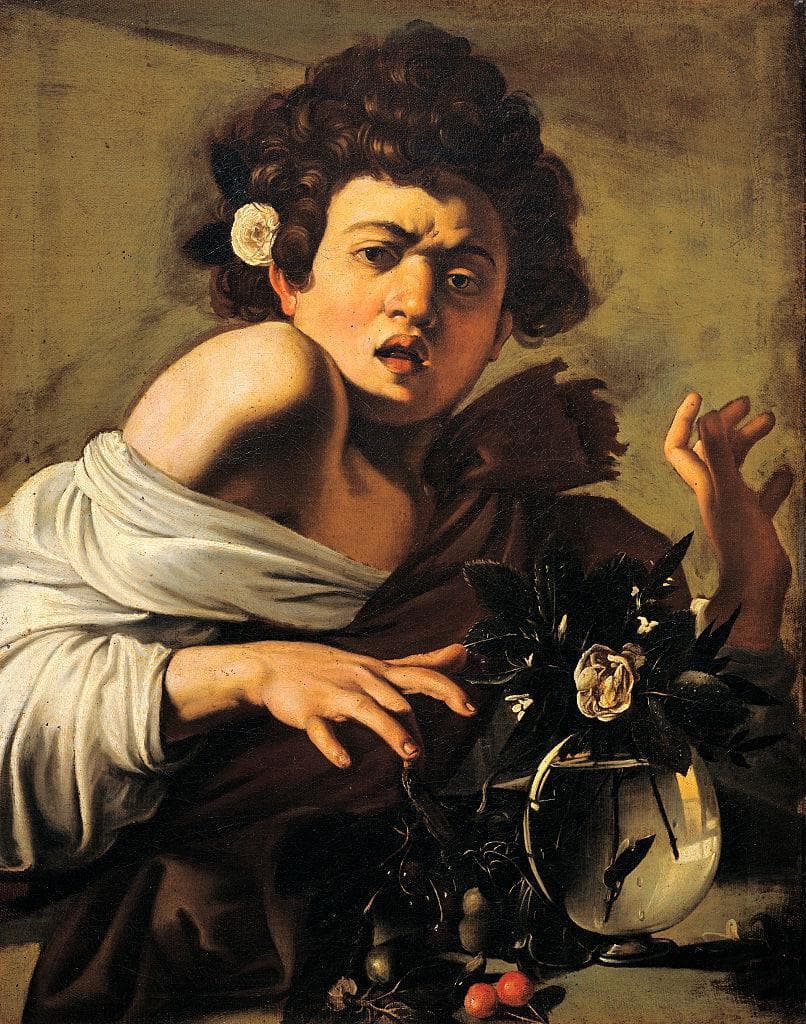
Both conceptually and formally, the painting is closely connected to another masterpiece from Caravaggio's youth, Boy Bitten by a Lizard.
Indeed, it has been suggested that the two paintings – the newly rediscovered work having previously been known only through copies – formed part of a series devoted to allegorical representations of the five senses, a subject particularly popular in the artists' workshops Caravaggio frequented soon after arriving in Rome.
Under this interpretation, Boy Bitten by a Lizard would represent touch, while Young Man with a Jug of Roses would symbolise smell.
We know from Merisi's friend and biographer, the physician Giulio Mancini, that the artist painted Boy Bitten by a Lizard "to sell" – in other words, for the open market rather than for a specific patron.
He was capitalising on the success of his half-length figure paintings in Rome's artistic circles, among the most vibrant in Europe at the time.
The exceptionally close relationship between the two works suggests that Young Man with a Jug of Roses had similar origins and was destined for the same market.
It was probably painted soon afterwards, in 1596–1597, following the success of Boy Bitten by a Lizard, which contemporaries hailed as the painting that first made Caravaggio famous.
Initially, the artist earned only a few coins from it, but before long the work's value had soared.
Roses, desire and the fleeting nature of youth
The lyrical, dreamlike atmosphere that emanates from Young Man with a Jug of Roses seems, in fact, to mark a further step beyond Boy Bitten by a Lizard.
In the latter, Caravaggio's exploration of sudden emotional reactions is so powerful that it almost overwhelms the still-life elements.
The face of the young man in the newly rediscovered painting, by contrast, is calmer and more seductive, yet tinged with melancholy.
The rose, the quintessential symbol of love in Baroque poetry, takes centre stage here, with buds and fading blossoms marking the passing of time.
This is anything but a still life: it is a living, breathing image.
Once again, Caravaggio leaves the work open to multiple interpretations. Like reality itself, it carries many meanings.
The flower with its thorns embodies the ambiguity of love, which draws us irresistibly towards it while simultaneously inflicting pain.
Once more, we encounter the inseparable union of pleasure and bitterness, of delight and the danger concealed within it – not least the bitter end of everything we love, whether in the passing moment or in the ultimate finality of death.
In this painting, we have recovered the missing link between the Caravaggio as he was and the artist he would become.
In the sorrow of fleeting youth and the sting of love, we can already glimpse the drama of Caravaggio's mature work, in which he would be compelled to confront the end of things and question the very meaning of reality and life itself.
Maria Cristina Terzaghi is an art historian and professor at Roma Tre University, and one of the world's leading authorities on Caravaggio.
This article was reviewed by an external translation partner